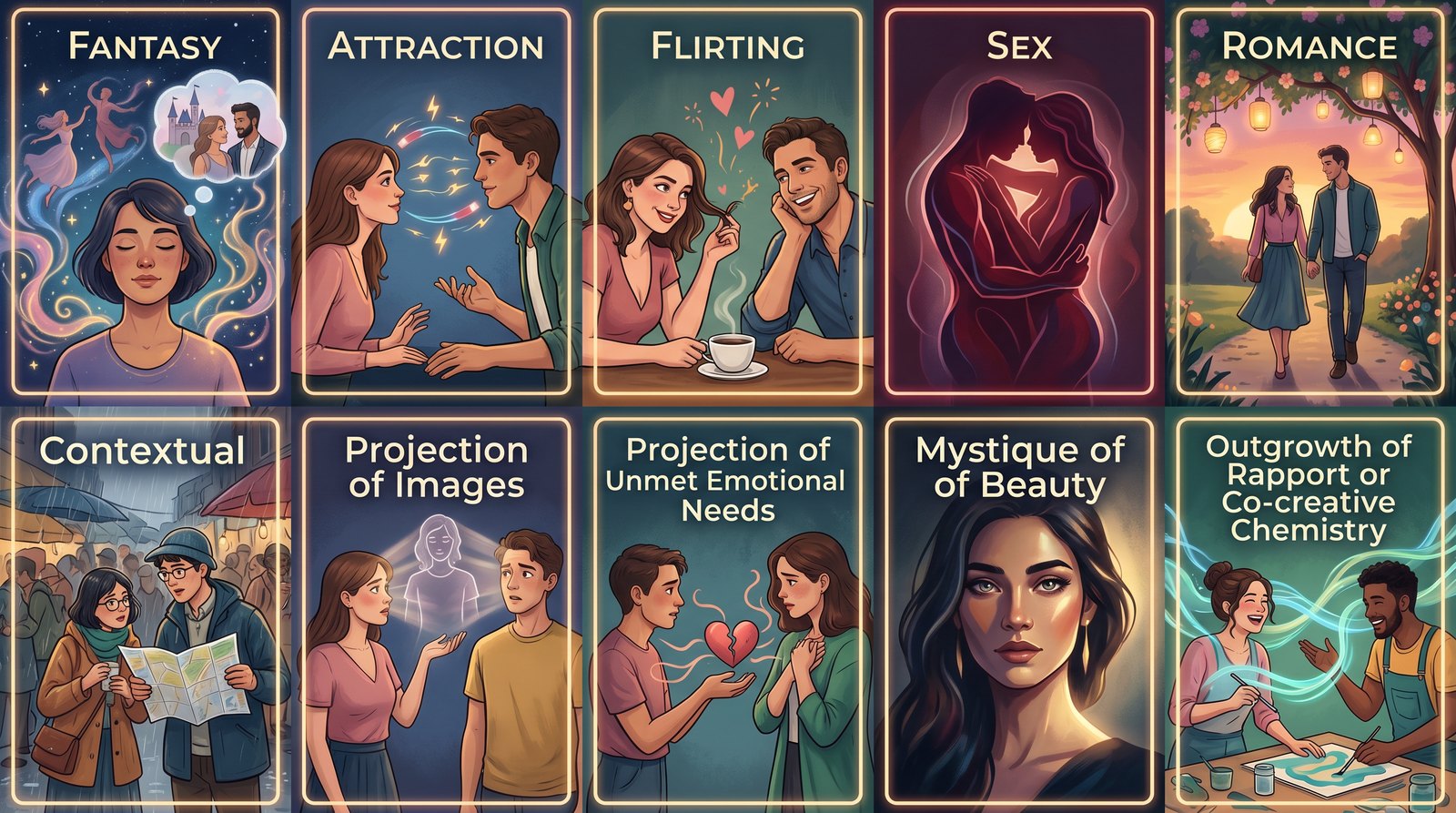
For too long, many of us have been winging it in relationships and dating — unprepared for the emotional minefields that derail connections or blow things up entirely. This guide identifies ten of those minefields and explores the challenges they pose. My hope is that you can avoid some of the unnecessary pain I went through, increase your capacity for connection, and transform doubt and confusion into confidence, clarity, and momentum.
Type 1: Attraction Based on Fantasy
Fantasy is natural, private, and consequence-free — purely imagination at play. Usually someone physically appealing catches your eye, your imagination kicks in, and you're spinning mental images like movie trailers. Then, just as quickly, you're back in your day-to-day life.
My experience of this I called "the hug." It was one of those days — back-to-back clients, little sleep, bad mood. I had 15 minutes and walked to the See's Candy shop to visit my friend Carol. She always gave me free samples and a warm smile. When it was time to go, we moved into a spontaneous hug, our first. It was unexpectedly warm and lingered longer than either of us anticipated. Then I saw it: her face flushed red. We had both been unexpectedly turned on. My imagination hijacked the moment, but the clock snapped me out of it. I made a swift exit. Had I crossed that line, I'd likely have lost both Carol and the simple joy of See's Candy. Instead, I could still stop by, enjoy a sample, and share a friendly hug without regret.
The lesson: Notice when your imagination is active, but do not mistake it for reality and an invitation to act. A fantasy is a fantasy unless it's acted on.
Type 2: Sexual Attraction
Sexual attraction is the pull you feel when someone's presence lights up your body. It's magnetic, visceral, and undeniable — but it can be incredibly misleading. Just because your body responds doesn't mean the person is good for you, or that there's any foundation for a connection or a continued relationship.
My experience of this I called "the gym." Years ago, I noticed a woman at the gym where I work out, whose presence stirred something deep and primal. Every time she passed, I got a jolt. But I also noticed I'd had perhaps a single word with her. My imagination was building a whole fantasy life based solely on my body's reaction. You're projecting; you're responding to energy, not reality, I was thinking to myself. That awareness saved me from chasing a feeling that had no grounding.
The lesson: Sexual attraction is a surge of energy, not a roadmap. You can feel the charge without acting on it — and enjoy it without acting on it. Acting on it would probably take all the fun out of it.
Type 3: Sexually Based Relationships
A sexually based relationship is one where physical intimacy is the main source of connection. The sex may be amazing, but once the high wears off, there may be little else holding things together.
A client of mine had been in a relationship for nearly a year. It was fun, passionate, and affectionate. But every time they tried to talk about deeper issues, the conversation would stall. They'd end up back in bed instead. Eventually my client said, "We're physically close, but I don't feel truly seen."
The lesson: Sex is powerful, but it's not the whole picture. Ask yourself: What do we share beyond the bedroom? Do I feel emotionally safe and known? How intimate are you really, beyond the sex?
Type 4: Flirting
Flirting is playful, charged energy — a way of testing connection or attraction. But it can also be a mask. Some people flirt compulsively as a substitute for real intimacy.
I worked with someone known as "the charmer." He was magnetic, sparking interest effortlessly, but his partners would say, "I never really felt like you let me in." Flirting was his shield — he was a master at the spark, but terrified of deeper exposure.
The lesson: Flirting can be beautiful, but it can't carry the weight of a relationship. Real intimacy asks for presence and vulnerability. Flirting is great, but not knowing when you're flirting can cause confusion and disillusionment based on what unfolds as a result.
Type 5: Being in Love
Being in love is an altered state — euphoric idealization that distorts perception. You see what you want to see and filter out the rest.
The first time I fell in love, I was floating for days — until it came crashing down. She didn't feel the same. Even though I felt crushed, the night remained seared in my memory as one of the greatest moments of my life. Looking back, I saw only what I wanted to see. Once the blinders came off, I saw us both more clearly, my desire faded, and I was kind of wondering what I saw in her other than this really strong physical chemistry that I thought was love. That's the lesson.
The lesson: Like any high, being in love doesn't last. When the rush fades, reality returns — differences, imperfections, conflict. Many people mistake this shift for a problem with the relationship. But expecting to feel high every day is like expecting to stay drunk forever. It's infatuation, not love.
Type 6: Contextually Based Relationships
Some relationships blossom in specific contexts but don't hold up when the context disappears. Examples: retreats where people are very close and intimate because of the processes that go on; disasters that people have survived together; creative collaborations like actors in a love story; people you meet traveling (the "stranger on the train" effect); and the COVID pandemic.
Drew and Marlon met on a dating app days before lockdown. They moved in together when isolation made dating otherwise impossible. For a year, they continued to see each other and it seemed to work. But once the restrictions lifted, their differences emerged. Drew craved space; Marlon interpreted this as rejection. They had never practiced navigating conflict. Pandemic conditions had masked their incompatibilities. Drew later said, "I wish we could start all over and build a foundation, not just ride the momentum."
The lesson: Context-based intensity is situational. When the context shifts, approach the relationship with curiosity and a clean slate — a fresh new beginning.
Type 7: Projection of Images
Projection occurs when a memory or image from a book, movie, or formative experience becomes embedded in your unconscious and is projected onto the person you're with. You're relating to a figment of your imagination.
From age 16 to 23, I carried on a secret love affair with a figment of mine — "Mrs. Taylor," a character from an adult novel I discovered just before my 16th birthday. From that point on, every person I met fell short by comparison. I was relating to an image, not a person, which made it impossible to forge genuine connections with anyone.
The lesson: When your standard for "real" is imaginary, it won't end well. It invariably leads to a crash when you're face-to-face with the sobering contrast between the image and the real person.
Type 8: Projection of Unmet Emotional Needs
There is a backlog of pain from unmet needs desperate for relief, which unconsciously drives us toward those we're drawn to.
Kathy was the first relationship in my life. I was 23; she was 38. I was desperate for validation at the time — to be seen, understood, and desired. She had left a 30-year marriage and was starved for connection. We were perfectly matched in our neediness. We stayed together for six years. The first three were blissful; the next three were tumultuous. As I became more conscious and connected within myself, I was drawn to others who were the same. Our unmet needs had been met, and with them, the foundation of the relationship dissolved.
The lesson: Dependency-based relationships work as long as the needs are being met. When they are met, you may outgrow the relationship.
Type 9: The Mystique of Beauty
Beauty is too often mistaken for virtue. We are conditioned to pedestalize people based solely on outward appearance while remaining blind to what lies beneath.
I met Priscilla at a therapy conference — great conversations, natural beauty, earthy presence. By the end, I had made her into someone custom-fit for myself. I bought a plane ticket to LA. As soon as she picked me up at the airport, I had a sinking feeling. She looked different — dressed up, covered in makeup. Her lifestyle struck me as materialistic. I spent the entire flight home trying to figure out how to make sure nothing like that ever happened again.
The lesson: There is no correlation between beauty and the kind of person someone is, or what it's like to be in a relationship with them. The quality of connection always depends on discovering depth — what lies beneath the surface.
Type 10: Attraction as an Outgrowth of Rapport and Intimacy
One of the most eye-opening experiences of my life was discovering how turned on I got just by being in a space of co-creation — a conversation, closeness, connection in their purest forms.
I experienced this on my first day with my wife, who I have been married to for 40 years. Taye and I met at a mutual friend's house and immediately hit it off. We spent three glorious hours together, laughing and sharing about anything and everything — until the waiter dropped the check and practically ushered us out the door.
I said, "I'm having such a good time, I think I'll get the check." Her face soured. "What do you mean you're going to get the check because you're having a good time?" She was expecting me to just get the check anyway. Things were going downhill fast. After a pause, as we tried to talk it through, she became vulnerable, tears in her eyes. "I just really love to be treated for dinner. It makes me feel special. It came out all wrong — that's not really who I am. I'm sorry about how I reacted."
I felt understood. I took an about-face from zero back to ten in three seconds. When I got that she understood me, she reminded me what I was ultimately after — someone with whom we both felt safe enough to be honest and real with each other, even when uncomfortable; someone with whom we could get through the difficult conversations feeling closer as a result. Forty-plus years later, we are in the advanced stages of an ever-growing relationship, with two children and a grandson to show for our co-creation.
The lesson: Connection and intimacy are bona fide, standalone sources of nourishment and a foundation for a relationship. It's connection we're ultimately after, and it's connection that sustains us.
The Core Insight: Awareness Is Everything
The thread that we weave through every type is the critical importance of awareness. Whether you're caught in fantasy, sexual attraction, the high of being in love, flirting, or the projection of unmet needs — consciousness is your lifeline. When you can recognize these patterns as they arise, you gain the power to choose your response rather than being unconsciously driven in the opposite direction from where you wish to be heading.
The destination we're all seeking is what I call the womb space of co-creation — that sacred place where two conscious individuals come together not from neediness or unconscious drive, but from wholeness and choice. This is where the miracle of true connection becomes possible.
Related reading: Dispelling Myths · The Sacred Space of Co-creation
Daniel A. Linder, MFT is a Licensed Marriage and Family Therapist and the creator of The Relationship Model of Addiction™ (TRMA™) — a framework for understanding addiction and relationships as a lifelong journey toward emotional nourishment and connection. Learn more at RelationshipVision.com.
Purchase This Article as an eBook
Free Download: The 5 Things Nobody Tells You About Recovery
Enter your name and email. We’ll send you a quick confirmation link — click it and your free guide arrives right away.
No spam; unsubscribe anytime.