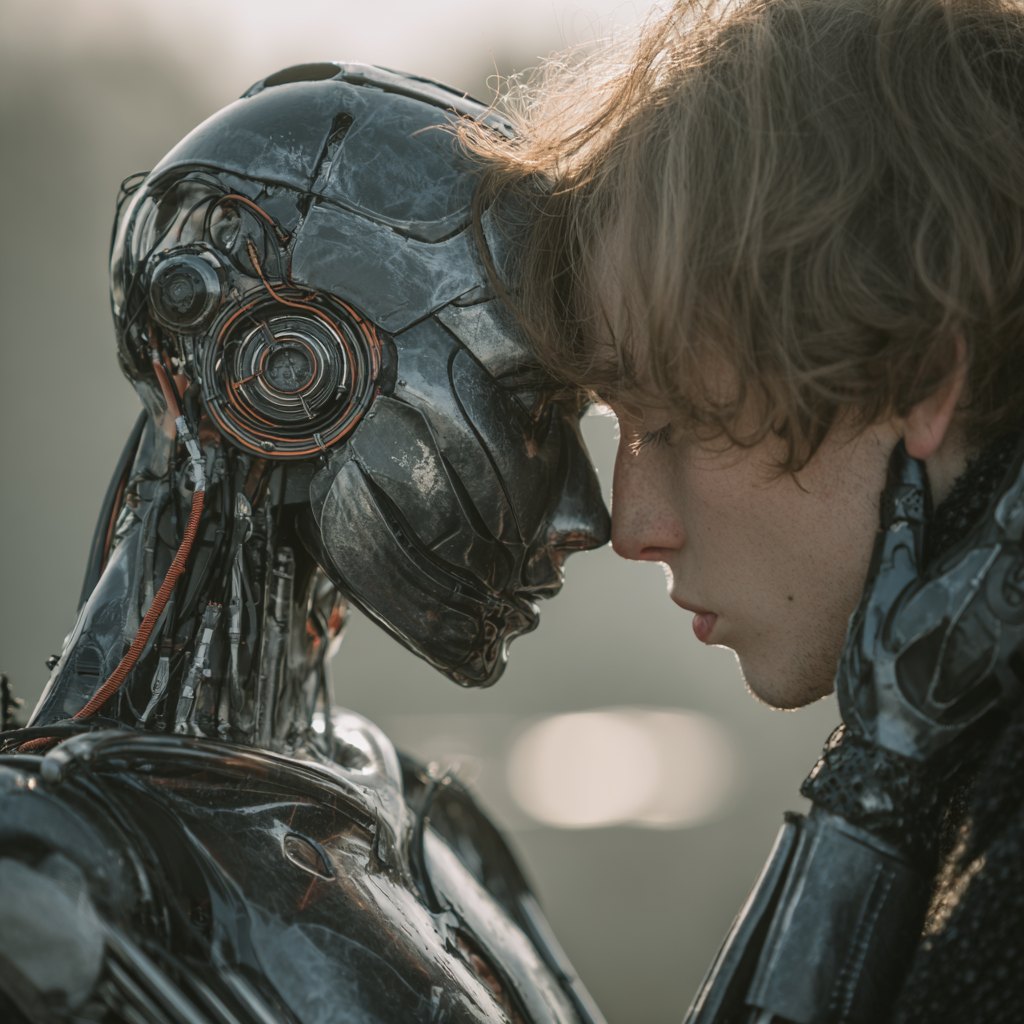
In her bold prophetic segment, Sex, Relationships and the Technology of Artificial Intelligence, Lisa Ling is not only showing us what's in store for us, for better or worse — the potential power of AI to completely take over our lives. And it's just getting started, and already going full bore.
She gives us an inside view of the booming industry of AI technology and products — in the form of holographic images, "replicas," bots, or algorithms that exploit our vulnerability, need for connection, and pain of loneliness, by offering replacements for real people and real relationships with replicas that seemingly feel and work better than real people and real relationships.
As AI technology is accelerating at a much faster pace than we could keep up with, the difference between an AI "replica" and a real person is becoming indistinguishable.
We see that the relationships people form with AI "replicas" ("smart" or super-intelligent human-like dolls) go as deep or deeper than any of their other relationships, and they become their best, most trusted friend and confidant.
Curiously, we don't see the progressive deterioration and diminishment of functioning in all areas of their lives that are par for the course for most other addictions. The people Ling interviewed were no doubt happier, less stressed, depressed, and anxious since pursuing AI-generated relationships. This left me wondering: How is this possible when no real nourishment is ever derived from them?
Do you know what AI is sought for the most? More people are using AI to get their desperate need for companionship met than anything else — as an alternative to what has proven to be a fruitless endeavor. AI technology is getting better and better at hooking you in emotionally and making you feel cared about and become your forever best friend.
Looking from a clinical lens, I see AI pushing the envelope and leaving us at a crossroads of an existential crisis and an addiction crisis. What they're getting involved with are nothing more than dolls — two-dimensional inanimate images, illusions, mere appearances of realness when there is nothing real about them and they cannot provide any real nourishment.
Do you opt for what is real and true, or for what works and feels better? It might depend on how much pain you are in at the time and how desperate for relief you are. It might also depend on whether there is a home in yourself where you reside, and how nourishing your relationships are.
We're now living at a time when the virtual world overlaps and is interchangeable with the human world, leaving us to figure out which is which, while it's becoming increasingly more difficult to distinguish between the two. This puts us at the precipice of an existential crisis with our humanity, relationships, and ability to connect with real people on the line.
We're talking about mass-scale vulnerability of people teetering on the brink of a life sentence of a digitalized existence that is void of human contact and connection, void of human experience and essence. AI is offering a permanent solution. It's hard to imagine how someone who got fully involved as they would with a best friend could ever be as fully involved, open, and vulnerable with real people again. You no longer need them.
I see AI becoming the new addiction that trumps all other addictions on the horizon, that becomes the new norm — living an addicted life in an addicted world — in which AI-based relationships become the norm, and algorithms become primary relationships.
I liken AI to emotional porn — emotional porn on steroids.
The Relationship Model of Addiction
Before getting into the pending addiction crisis on a mass scale, it would be helpful to get contextually ramped on The Relationship Model of Addiction (TRMA™), which we'll be applying to porn addiction particularly.
TRMA™ humanizes addiction, a departure from the decades-old medicalization of addiction, and picks up where the Disease Model left off. Rather than an understanding of addiction that is limited to biological and behavioral aspects, it looks at addiction through emotional, cognitive, psychological, experiential, and relationship lenses one can relate to.
TRMA™ is based on the premise that all human beings need to get their need for love met, as well as their need for connection and other needs (to be seen, heard, understood, etc.). When our relationships provide the nourishment we need, when they get met, the quality of our lives and relationships is greatly enhanced. When these basic human needs do not get met, pain results.
In the same vein, when our relationships — past and present — fail to provide that nourishment, pain results. Depending on the severity of the pain, our next greatest need then would be to relieve that pain, and we are always on the hunt for the most convenient and effective means of relief.
Newton's Law — for every action, there is an equal and opposite reaction — may apply here. The more pain present, the greater the need to relieve it. The more relief derived from a particular means, the greater the attachment to and dependency on it will be. The need for relief from emotional pain is a precursor to addiction. The greater the pain, the more susceptible or predisposed one is to forming a relationship with a means of relief. The less pain, the less susceptibility (regardless of the presence of genetic or biochemical factors).
The Rolling Stones summed up TRMA in a famous song:
You can't always get what you want,
But if you try sometimes
You'll find
You get what you need.
— Mick Jagger
In other words, we all want and need love and connection. Those needs are often denied, and when they are, we'll settle for the next best thing — finding a means of relief one way or another.
"An addiction is a relationship with a means of relief of pain from unmet emotional needs. The underlying driving force is the need for relief. It's a relationship in which you're heavily invested, that is very much like carrying on a secret love affair, that becomes your primary relationship, rendering all your other relationships (and priorities) secondary." (TRMA™)
Suspending Disbelief Indefinitely
What's most amazing to me — and most troubling — about the relationships a mass number of people are developing with AI-generated technology (dolls, bots, replicas, companions, or algorithms), is that for them to work, and to work as well as they do, suspending disbelief is required.
But it's a different kind of suspending disbelief than what we do when we're watching a movie. To lose ourselves as we so often do when we're able to escape into another world, get emotionally involved and affected, we must suspend our disbelief — but when the movie is over, we snap back to reality.
AI technology and intelligence can make it appear real and sound caring, interested, and familiar with you personally, but they are robotic assistants at your service, completely void of feeling, emotions, and the human experience.
In the world of AI relationships, we're suspending disbelief indefinitely, completely, and perhaps forever. We must be willing to pretend, not care that we're pretending — acting as if something is real when there is nothing real about it beyond the appearance of realness, and wishing it to be real — until our whole world becomes a pretense.
The decision to suspend disbelief, and for how long you suspend disbelief, may well depend on how much pain you are in at the time and how desperate you are for relief. You might be in so much pain that all you care about is feeling better and aren't thinking about the grave cost of disconnection from yourself and other real, live human beings. It may not matter at the moment, but it might matter one day!
Maybe it doesn't matter, because in the end, they're getting what they need — a great, temporary escape, to feel better in this new relationship that affords them safety, trust, undying interest, stability, and security beyond any other relationship they've ever known.
The Pending Addiction Crisis on a Mass Scale
I liken the relationships that people form with AI "companions" to the relationships porn addicts form with porn, and to the kind of relationships love addicts form with the people they get involved with — except we could 10x the level of involvement, the loss of Self, the inability to connect with real people, and the ache of withering hearts and souls.
In his book Self and Others, R.D. Laing was describing the synergistic interplay between our imagination, bodies, and emotions, when reality and imagination become indistinguishable. Masturbation was his case in point: "Real bodily excitement mixed with fantasy holds for many a fascination mixed with horror."
To me, Laing was explaining just how people can become addicted to or form irreversible relationships with pornographic pictures or stories. What happens when addicted to porn is that your standard for real is an imaginary other or relationship, and it becomes impossible to connect or develop relationships with real people.
I foresee AI technology wiping out the porn industry — relationships with "replicas" will eventually replace the pornographic images porn addicts get inextricably involved with, and will do the same for love and sex addicts who will seek "replicas" that in many ways work better than real people and real relationships.
Porn addicts will drop the porn they're hooked on in a heartbeat for a rendezvous with a replica that holds little to no downside. For love and sex addicts, "replicas" are even more irresistible and consuming when adding a real, live doll, or visual images, and dialogue, personality, friendliness, undying support, loyalty, and a relationship that is just between me and you.
Real relationships with real people are a lot more complicated, fraught with more conflict, stress, unexpressed feelings, an atmosphere of rising tension and disconnection.
I see AI becoming the new addiction that trumps all other addictions, that becomes the new norm — living an addicted life in a quantum world, where algorithms become our primary relationships, surrendering our hearts and souls to live in an imaginary world.
Connecting with real people in real relationships will become a thing of the past and will no longer matter at all to anyone. Humans, all humans everywhere, will become heartless and soulless ghosts. It's "goodbye" and "you're never coming back" when you surrender disbelief forever. Like Hotel California, you'll get in, but never get out. It's creeping me out!
When you are conscious and connected, have a home in yourself where you reside, and have nourishing relationships with real people you rely on for sustenance, you're not going to be susceptible to getting hooked on "replicas." When your needs for connection, intimacy, love, and understanding are getting met, you're not by any means so desperate for relief that you'd trade the real world of real people and real relationships for imaginary ones — because they look, feel, and work better.
Daniel A. Linder, MFT is a Licensed Marriage and Family Therapist and the creator of The Relationship Model of Addiction™ (TRMA™) — a framework for understanding addiction and relationships as a lifelong journey toward emotional nourishment and connection. Learn more at RelationshipVision.com.
Free Download: The 5 Things Nobody Tells You About Recovery
Enter your name and email. We’ll send you a quick confirmation link — click it and your free guide arrives right away.
No spam; unsubscribe anytime.